

Introduction
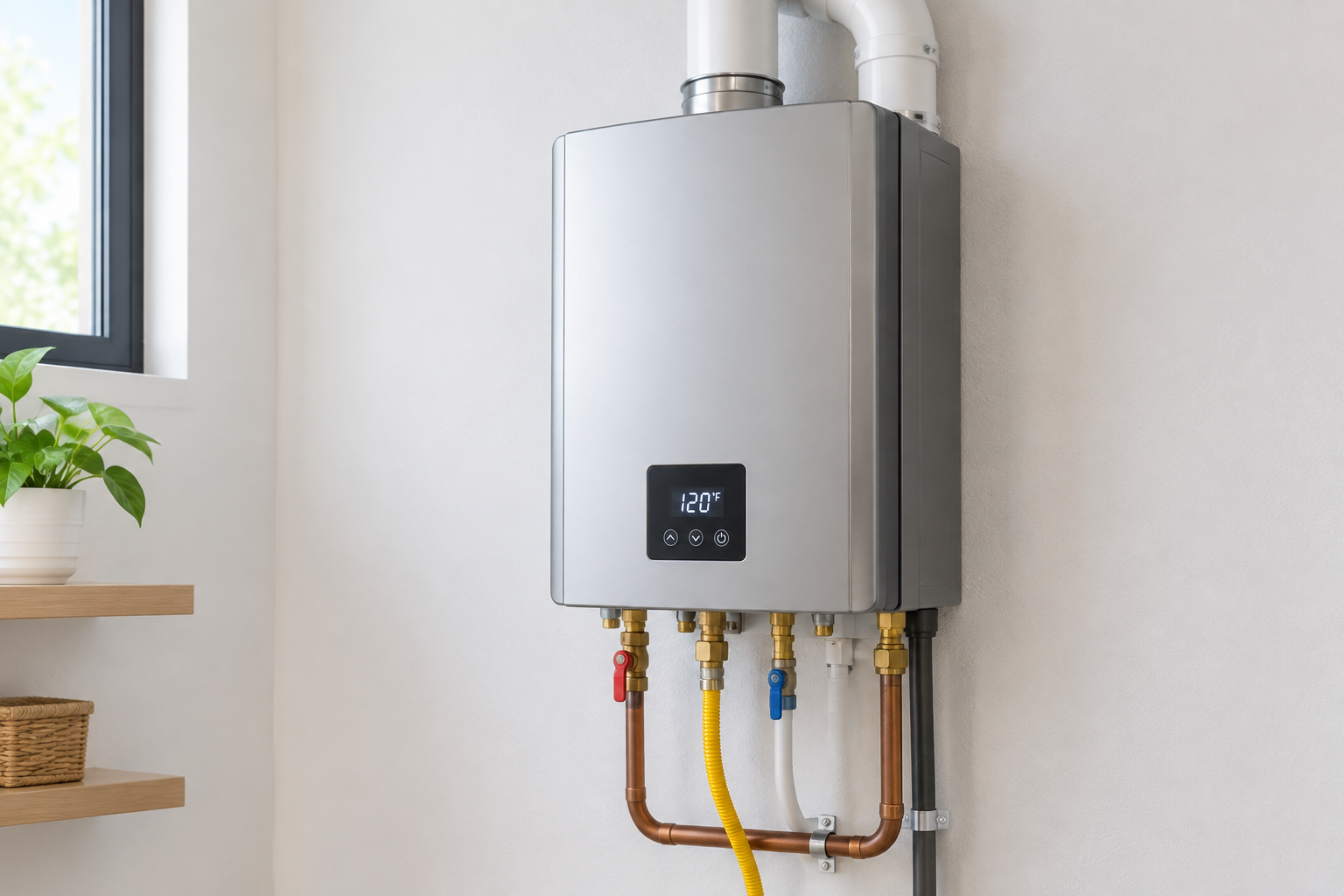
A tankless water heater swaps the big insulated tank in your basement for a compact, wall-mounted unit that heats water only when you open a tap. That one change explains nearly everything people like and dislike about it: no energy wasted keeping 40 gallons hot all day, a smaller footprint, and a longer lifespan, but also a higher price, more demanding installation, and a firm limit on how much hot water it can deliver at once. Whether it's a good fit depends on your household, your fuel, and how well the unit is sized. This guide covers how tankless units work, the different types, what they really cost, how to size one, which brands are worth knowing, and how to keep one running for 15 to 20 years.
Key Points
- It heats water as it flows. There's no storage tank, so you avoid standby heat loss, and a properly sized unit won't run out the way a tank can.
- It isn't truly unlimited. Every unit has a maximum flow rate in gallons per minute (GPM), and it drops as your incoming water gets colder.
- Efficiency gains are real but modest. The Department of Energy puts the savings at 24% to 34% for homes using about 41 gallons a day or less, and 8% to 14% for households using around 86 gallons.
- Installation is where the money goes. Gas models often need a larger gas line and new venting, while whole-house electric models can need a major electrical upgrade.
- Hard water is the biggest threat. Mineral scale builds up inside the heat exchanger, so annual descaling is the one maintenance task you shouldn't skip.
- Sizing matters more than brand. A mid-priced unit that matches your peak demand will outperform a premium one that's too small.
- The federal tax credit is gone. It ended after 2025, so check state and utility rebates before you buy.
| Feature | Tankless water heater | Storage Tank water Heater |
|---|---|---|
| Hot water supply | Continuous, up to the unit's flow limit | Limited to the tank size until it recovers |
| Typical lifespan | 15 to 20 years or more with care | 10 to 15 years |
| Efficiency | 24% to 34% better for low-use homes (DOE) | Loses heat to standby |
| Installed cost | Roughly $1,400 to $5,600 | Roughly $800 to $3,100 |
| Space | Small, wall-mounted | Takes up floor space |
| Main weakness | Flow limits and scale buildup | Runs out and can flood when it fails |
| During a power outage | Usually no hot water | Gas tanks may still work |
What Is a Tankless Water Heater?
Short answer: A tankless water heater, also called an on-demand or instantaneous water heater, heats water directly as it passes through the unit instead of storing it in a tank.
You'll see the same appliance called a demand-type, instant, or continuous-flow water heater. The point is the same in every case: when a hot tap opens, cold water flows in, gets heated in seconds, and flows out to your fixture. When the tap closes, the heater shuts off and uses almost no energy. A traditional storage heater, by contrast, keeps a tank of water hot around the clock whether anyone needs it or not. Some units you'll see labeled "hybrid" are actually heat pump water heaters, which still use a tank but heat it very efficiently with electricity, so they belong in a different category.
How Does a Tankless Water Heater Work?
Short answer: When you open a hot tap, a flow sensor detects the water moving, the control board fires a gas burner or electric elements, and the water is heated as it passes through the heat exchanger on its way to your fixture.
Here's the sequence in a little more detail:
- Water starts flowing. Cold water enters through the inlet, and the flow sensor confirms it's moving. Most units need a minimum flow of around 0.5 GPM before they'll fire, which is why a barely open faucet can leave you with cold water.
- The heater ignites. In a gas model, the burner lights and heats the heat exchanger. In an electric model, heating elements switch on.
- Temperature is regulated. Temperature sensors and a modulating burner or variable element power adjust the output to hold your set temperature, usually 120°F.
- Exhaust leaves safely. Gas units send combustion gases out through an exhaust vent, and condensing models also drain a small amount of acidic condensate.
- It shuts off. When you close the tap, the flow stops and the heater turns off.
Types of Tankless Water Heaters
Short answer: Tankless units are categorized by fuel (gas, propane, or electric), by how much of the house they serve (whole-house or point-of-use), and by how they vent (condensing or non-condensing).
By Fuel: Gas, Propane, and Electric
| Type | Typical Strenght | Typical Installed Cost | Main Requirement |
|---|---|---|---|
| Natural gas | Highest flow rates, up to about 11 GPM | $2,100 to $5,600 | Adequate gas line and venting |
| Propane | Similar output to natural gas | Similar to natural gas | Propane supply and venting |
| Electric whole-house | Simplest install, no venting | $1,400 to $3,500 | Large dedicated electrical capacity |
| Electric point-of-use | Serves a single sink or bath | $450 to $1,500 | A nearby outlet or circuit |
Gas and propane units are the usual choice for whole-house use because they can deliver far more hot water per minute. Electric models are cheaper to buy and install, have no venting, and run at very high conversion efficiency, but they're limited by how much power your home can supply. A 27 kW whole-house unit, for example, pulls about 112 amps at 240 volts, which is why many older panels can't handle one without an upgrade. Efficiency isn't the same as operating cost, either: electric is more efficient at turning energy into heat, but gas is often cheaper per unit of heat, so your local utility rates matter as much as the numbers on the label.
Whole-House vs. Point-of-Use
A whole-house unit replaces your tank and serves every fixture. A point-of-use unit is a small heater, usually electric, installed right next to one sink, shower, or appliance. Point-of-use models are great for a far-off bathroom, a garage sink, or an addition, and because the hot water travels only a short distance, they cut down on the wait and the wasted water. They're typically limited to around 1.5 GPM, enough for light use but not a full shower plus anything else.
Condensing vs. Non-Condensing
A non-condensing gas unit vents hot exhaust, so it needs heat-resistant stainless steel venting. A condensing unit has a second heat exchanger that pulls extra heat out of the exhaust, which raises efficiency (often to a UEF around 0.95 or higher) and allows cooler exhaust that can use PVC or similar plastic venting. The trade-offs are a higher price and a condensate drain, since the condensate is slightly acidic and usually needs a neutralizer before it goes down a drain.
Tankless Water Heater Benefits
Short answer: The main benefits are lower standby energy loss, hot water that doesn't run out within the unit's capacity, a longer service life, and a much smaller footprint.
- Less wasted energy. Because water is heated on demand, you avoid the standby loss of keeping a tank hot all day.
- Continuous hot water. A properly sized unit keeps producing hot water as long as the demand stays within its flow rate, so back-to-back showers aren't a problem.
- Longer lifespan. Units are commonly quoted at 20 years or more, roughly double a storage tank, though 15 to 20 is a safer planning range if you have hard water.
- Space savings. A wall-mounted unit frees up floor space in a closet, basement, or garage.
- Smaller leak risk. A failing tank can dump 40 to 50 gallons of water, while a tankless unit holds only a small amount.
- Replaceable parts. Many components can be serviced or replaced individually, which can extend the life of the unit.
Disadvantages and Limits of a Tankless Water Heater
Short answer: Tankless units cost more up front, can be overwhelmed by too many fixtures running at once, need more demanding installation, and are sensitive to hard water scale.
- Higher upfront cost. The unit and the installation both cost more than a like-for-like tank swap.
- Flow limits. If you run two showers, a dishwasher, and a washing machine together, you can exceed capacity and the water turns lukewarm.
- The cold-water sandwich. If you turn the hot water off briefly and then on again, you can get a short blast of cold water between two bursts of hot, because the heater has to shut down and restart. Many newer models reduce this, and recirculation or a small buffer tank can help.
- Delayed hot water. A tankless heater doesn't make hot water arrive faster, because it still has to travel through your pipes. A recirculation pump is the fix if you have a long run.
- Installation complexity. Gas line sizing, venting, condensate drainage, and electrical capacity all have to line up.
- Power outages. Most models, including gas ones, need electricity to run the controls and fan, so you'll have no hot water in an outage without a backup.
- Scale sensitivity. Hard water deposits clog the heat exchanger faster in a tankless unit than they affect a tank, which is why regular descaling is not optional.
Is a Tankless Water Heater Worth It?
Short answer: For many homes it pays off through lifespan, space, and steady hot water rather than through energy bills alone, since the monthly savings are modest and payback often takes a decade or more.
The honest math looks like this. Average annual energy costs run roughly $220 to $480 for a gas tankless unit versus $250 to $420 for a gas tank, and about $340 to $540 for electric tankless versus $530 to $600 for an electric tank. If a tankless setup costs $2,000 more installed and saves about $100 a year, the energy savings alone take around 20 years to repay it. What tips the scale is that a tankless unit can last roughly twice as long, so you may avoid buying a second tank, and you gain space and hot water that doesn't run out.
A tankless unit tends to be a good fit if you:
- Have a small to mid-sized household, or lower hot water use
- Plan to stay in the home long term
- Are short on space or building an addition
- Are tired of running out of hot water
It's a weaker fit if you have very high simultaneous demand and don't want to size up or install a second unit, you may move soon, your water is very hard and you don't plan to maintain it, or your electrical service can't support an electric model.
On incentives, the federal Energy Efficient Home Improvement Credit that used to cover efficient water heaters ended for installations after December 31, 2025. State and utility rebates are separate programs and may still apply, so check with your gas or electric provider before you buy.
What Size Tankless Water Heater Do You Need?
Short answer: Size a tankless water heater by adding up the hot water flow (GPM) of every fixture you might run at once, then choosing a unit that can deliver that flow at your required temperature rise.
Two numbers do all the work. The first is your peak flow rate. The second is the temperature rise, which is your target temperature (usually 120°F) minus your incoming groundwater temperature. If your groundwater is 50°F, you need a 70°F rise. Groundwater can be 60 to 70°F in the South and 40 to 50°F in the North, and colder water means the unit has to work harder and delivers less flow.
| Fixture | Typical Hot Water Flow (GPM) |
|---|---|
| Shower | 2.0 to 2.5 |
| Kitchen sink | 1.0 to 1.5 |
| Bathroom sink | 0.5 to 1.0 |
| Dishwasher | 1.0 to 2.0 |
| Washing machine | 1.5 to 3.0 |
Add up only what you realistically run together. Two showers and a bathroom sink is about 6 GPM, while a shower plus the dishwasher is closer to 4 to 4.5 GPM. Then check the manufacturer's flow-versus-rise chart, because a headline GPM is often quoted at a mild temperature rise and drops sharply in cold climates. As a rough guide, a large gas unit rated near 199,000 BTU delivers about 7 GPM at a 50°F rise but only about 5 GPM at 70°F, while a 27 kW electric unit delivers roughly 3.5 GPM at 50°F and about 2.5 GPM at 70°F. Always size for your coldest winter water, not your summer water.
If one unit can't cover your peak demand, you can install two units, add a point-of-use heater for a distant bathroom, or simply reduce overlap by changing when big appliances run.
Tankless Water Heater Installation: What to Expect
Short answer: Installation is the most complicated and expensive part, because a tankless unit often needs a bigger gas line, new venting, or heavier electrical service than the tank it replaces, and it's a job for a licensed professional.
- Gas line sizing. A tankless gas unit can fire up to around 199,000 BTUs, while a typical gas tank fires roughly 30,000 to 40,000, so the gas line often has to be upsized, commonly from 1/2 inch to 3/4 inch.
- Venting. Non-condensing units need stainless steel venting, while condensing units can use PVC or similar plastic. Venting can go through a sidewall or the roof.
- Electrical service. Whole-house electric units need a dedicated, heavy-duty circuit, and sometimes a panel upgrade.
- Condensate drainage. Condensing models need a drain for the acidic condensate, usually with a neutralizer.
- Water supply and isolation valves. Installing service valves with flush ports makes future descaling much easier.
- Clearances, permits, and codes. Local codes dictate clearances and permits, and permits typically run about $50 to $200.
- Water hardness testing. It's smart to test your water hardness before you install so you can plan for a softener or scale filter.
How Much Does a Tankless Water Heater Cost?
Short answer: Most tankless water heaters cost about $1,400 to $3,500 installed for electric models and about $2,100 to $5,600 for gas models, depending on the unit, the installation, and any upgrades.
| Type | Unit Cost | Typical Installed Cost |
|---|---|---|
| Electric whole-house | $500 to $1,500 | $1,400 to $3,500 |
| Electric point-of-use | $150 to $500 | $450 to $1,100 |
| Gas, non-condensing | $700 to $1,500 | $1,900 to $4,400 |
| Gas, condensing | $1,200 to $3,000 | $2,700 to $6,000 |
These are national estimates drawn from several 2026 cost guides, so your price will shift with your region, the unit's capacity, and the condition of your existing plumbing. Common add-ons can push the total higher: a gas line upsize often adds $350 to $1,500, new venting about $250 to $600, a new electrical circuit $700 to $2,500, and an electrical panel upgrade $1,000 to $2,500 on top of that. Moving from a tank in a closet to a tankless unit in a new location costs more than a same-spot swap. For comparison, a standard tank heater typically runs about $800 to $1,500 installed, though it can reach $3,100 in some cases.
Tankless Water Heater Brands Worth Knowing
Short answer: Rinnai, Navien, Noritz, and Rheem are the best-known names for gas units, while EcoSmart and Stiebel Eltron are popular in electric models, but a correctly sized unit and a qualified installer matter more than the logo.
- Rinnai is a tankless specialist with a wide residential lineup, including condensing and recirculating models, and it's widely installed across North America.
- Navien is known for condensing units with stainless steel heat exchangers and built-in recirculation on many models.
- Noritz makes compact condensing models, including lines designed to replace existing tankless units with minimal changes.
- Rheem offers one of the broadest lineups, with value-priced gas and electric options and easy parts availability.
- Takagi is often chosen for compact installs and smaller or point-of-use applications.
- EcoSmart and Stiebel Eltron focus heavily on electric tankless units, from small point-of-use heaters to whole-house models.
- A. O. Smith and Bradford White also sell tankless lines, though both are better known for tank models.
- Eccotemp is popular for portable and outdoor propane units.
Heat exchanger warranties on major gas brands commonly run about 10 to 15 years, with some models offering more, but terms vary by model and often depend on professional installation, product registration, and sometimes proof of maintenance. Always confirm the warranty for the exact model you're buying.
Tankless Water Heater Maintenance
Short answer: Descale the unit once a year (every six months in very hard water), clean the inlet filter, and have the vent, burner, and condensate drain checked by a professional periodically.
A tankless unit doesn't need the tank flushing or anode rod checks that a storage heater does, so it's a different routine from the one in our water heater maintenance guide, but it isn't maintenance free.
How to Descale a Tankless Water Heater
Hard water leaves mineral scale on the heat exchanger, which reduces efficiency, causes noise, and can trigger error codes. Descaling dissolves it, and many homeowners can do it with a small kit:
- Turn off the power or gas and close the water and gas shutoff valves.
- Connect hoses to the service ports on the hot and cold isolation valves, then run them to a small submersible pump and a bucket.
- Fill the bucket with white vinegar or a descaling solution. Most manufacturers call for around 2 to 4 gallons of undiluted vinegar, so check your manual for the exact amount.
- Run the pump for 45 to 60 minutes so the solution circulates through the heat exchanger.
- Drain and rinse. Flush the unit with clean water for several minutes.
- Clean the inlet filter, reconnect everything, and restore power, water, and gas.
If your unit doesn't have service valves, a plumber can add them, which makes every future descaling easier.
Other Maintenance Tasks
- Clean the inlet water filter screen every few months or at least once a year.
- Inspect the exhaust vent and air intake for blockages, corrosion, or loose joints.
- Check the condensate drain and neutralizer on condensing models.
- Look for leaks around connections and the base of the unit.
- Schedule a professional inspection every year or two, which also keeps many warranties valid.
As a rough guide, a DIY descaling kit costs $20 to $50, while professional maintenance typically runs $150 to $350.
Does a Tankless Water Heater Work With Hard Water?
Short answer: Yes, but hard water speeds up scale buildup inside the heat exchanger, so you'll need to descale more often and consider a water softener or scale filter.
Water above roughly 7 grains per gallon is generally considered hard. A cheap test kit or a report from your water utility will tell you where you stand. If you're in a hard water area, plan to descale every six months, and a whole-house softener or a scale-prevention filter can dramatically slow the buildup. Some manufacturers use stainless steel heat exchangers that tolerate scale better, but no heat exchanger is immune, and skipped descaling is one of the most common reasons a tankless unit fails early.
Common Tankless Water Heater Problems and Fixes
Short answer: Most tankless problems come down to flow, scale, venting, or power, and many can be diagnosed from the symptom and the error code.
- No hot water. Check that the power and gas are on, the unit isn't tripping on a low flow below its activation point, and the vent isn't blocked. A tripped breaker or closed gas valve is a surprisingly common cause.
- Lukewarm or fluctuating water. You may be exceeding the unit's flow rate, or scale may be restricting the heat exchanger. Reduce simultaneous use, and descale if it's been a while.
- Cold-water sandwich. Wait a little longer between uses, run a steadier flow, or ask about a recirculation pump or buffer tank.
- Low hot water flow. A clogged inlet filter or a scaled heat exchanger is the usual culprit.
- Error codes. Codes vary by brand and usually point to ignition failure, flame failure, overheating, or a blocked vent, so check your manual before resetting.
- Rumbling or popping. Scale buildup is boiling water against deposits, and descaling usually fixes it.
- Water leaks. Tighten or replace loose fittings, and call a plumber if the leak comes from the unit itself.
- Frozen or blocked vent. Clear obstructions and make sure the unit's freeze protection is working, especially in cold climates.
When to Call a Professional
Anything involving gas lines, venting, electrical connections, or the internal components should go to a licensed plumber or HVAC technician. Call for help if you smell gas, see repeated error codes or lockouts, find a leak coming from the heat exchanger, or notice soot or discoloration near the vent. Skipping professional work on a gas appliance isn't just risky, it can void your warranty.
Frequently Asked Questions
How long does a tankless water heater last?
Most are quoted at 20 years or more, but 15 to 20 years is a realistic planning range. Hard water, skipped descaling, and poor installation are the biggest things that shorten it.
Are tankless water heaters energy efficient?
Yes. The Department of Energy says they can be 24% to 34% more energy efficient than storage tanks in homes using about 41 gallons of hot water a day or less, and 8% to 14% more efficient in homes using around 86 gallons.
Is gas or electric better for a tankless water heater?
Gas generally delivers more hot water per minute and suits larger households, while electric costs less to buy and install and avoids venting. Your local gas and electricity prices and your home's electrical capacity usually decide it.
Can a tankless water heater run multiple showers?
Yes, if it's sized for it. Two showers need about 4 to 5 GPM at your temperature rise, so confirm the unit's rating in your climate.
Can a tankless water heater replace a traditional tank?
Yes, but the swap often involves gas line, venting, or electrical changes, so the installation can cost more than the unit itself.
How often should a tankless water heater be flushed?
At least once a year, and about every six months if you have hard water.
What's the difference between condensing and non-condensing models?
A condensing unit captures extra heat from its exhaust, so it's more efficient and can use plastic venting, but it costs more and needs a condensate drain. A non-condensing unit costs less but needs stainless steel venting.
Do tankless water heaters need special venting?
Gas models do. Electric models don't need venting at all.
Does a tankless water heater need a minimum flow to turn on?
Yes, usually about 0.5 GPM, which is why a barely open tap can leave you with cold water.
Conclusion
A tankless water heater can be a great upgrade, as long as you go in with realistic expectations. It won't slash your bills overnight, but it can give you steady hot water, a longer-lasting appliance, and a lot of reclaimed floor space. Size it for your coldest winter water, budget for the installation work as much as the unit, test your water hardness, and put an annual descaling on the calendar. Do those four things and it should keep delivering hot water for well over a decade.