

Introduction
Most air conditioning repair calls trace back to a short list of culprits: a clogged filter, a failed capacitor, a refrigerant leak, a blocked drain line, or a thermostat that isn't doing what you told it to. The useful part is that several of those are things you can check yourself in about ten minutes, which can save you a service fee or at least help you describe the problem accurately when you do call someone. The rest, anything involving refrigerant, high-voltage wiring, or the compressor, belongs with a licensed technician. This guide walks through the symptoms you're most likely to see, what usually causes them, what's safe to try at home, what repairs actually cost, and how to decide between fixing an older system and replacing it.
| What You Notice | Likely Cause | DIY or Pro? |
|---|---|---|
| Warm air from the vents | Dirty filter, low refrigerant, failed capacitor or compressor | Check the filter first, then call a pro |
| AC won't turn on | Thermostat settings, tripped breaker, full drain pan switch, bad capacitor | Basic checks yourself, then a pro |
| Ice on the coil or refrigerant line | Restricted airflow or low refrigerant | Thaw it yourself, pro if it returns |
| Water around the indoor unit | Clogged condensate drain, cracked drain pan | Drain is often DIY, pan needs a pro |
| Grinding, squealing, or banging | Worn motor bearings, fan problem, compressor trouble | Pro |
| Burning smell | Overheating motor or electrical fault | Shut off, then a pro |
| Cycles on and off every few minutes | Short cycling from filter, thermostat, refrigerant, or sizing | Filter and thermostat DIY, rest pro |
What Is Air Conditioning Repair?
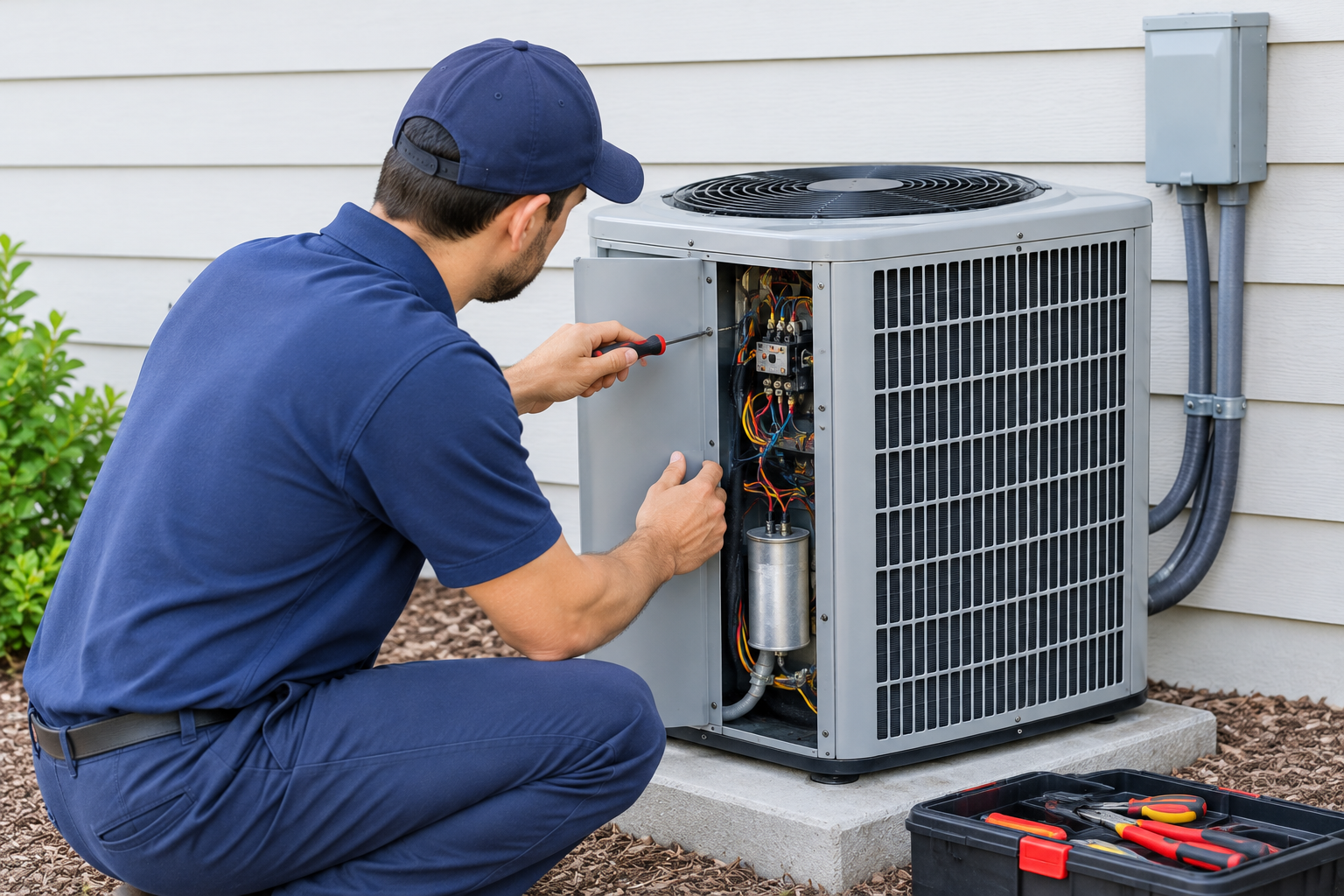
Air conditioning repair is the process of finding out why a cooling system has stopped working properly and restoring it, and it generally happens in three steps: inspecting the system to find the root cause, repairing or replacing the part that failed, and testing the system afterward to confirm it cools, drains, and shuts off safely. A repair can be as small as swapping a filter or as involved as replacing a compressor, and the difference usually comes down to which component failed and whether refrigerant or high-voltage wiring is involved.
How an Air Conditioner Works (and Where It Breaks Down)
An air conditioner doesn't create cold air so much as move heat out of your house. Refrigerant circulates through a closed loop of copper tubing. Indoors, the evaporator coil absorbs heat from the air that the blower motor pushes across it. The compressor then pressurizes that warm refrigerant and sends it outside to the condenser coil, where the condenser fan helps release the heat. An expansion valve drops the refrigerant's pressure so the cycle can start again, while the thermostat tells the whole system when to run and a condensate drain carries away the moisture pulled from your air.
Knowing that loop makes troubleshooting a lot less mysterious, because problems tend to cluster in a few places:
- Airflow parts, the filter, blower, vents, and ducts, which fail quietly and cause weak or uneven cooling.
- Starting parts, the capacitor and contactor, which are cheap but fail often, especially in hot weather.
- Coils and refrigerant lines, where dirt, ice, and leaks reduce how much heat the system can move.
- The compressor, the pump at the center of the system and the most expensive part to replace.
- The drain and pan, which handle condensation and cause water damage when they clog or crack.
Common Air Conditioning Problems and How to Fix Them
Here are the issues homeowners run into most often, what's usually behind each one, and where the line sits between a quick fix and a service call.
1. AC Not Cooling or Blowing Warm Air
Short answer: Start with the cheap checks: thermostat set to Cool and below the room temperature, a clean filter, and a clear outdoor unit. If the air is still warm, the cause is usually a failed capacitor, a refrigerant leak, or a compressor problem, and all three need a technician.
A quick way to narrow it down is to look at the outdoor unit while the system is running. If the fan isn't spinning, a bad capacitor or contactor is a likely suspect. If the fan spins but the air inside is still warm, low refrigerant or a compressor issue is more likely. Resist the urge to keep running the system for days hoping it sorts itself out, since operating with low refrigerant or a struggling compressor can turn a modest repair into a major one.
2. AC Won't Turn On
Short answer: Check three things in order: the thermostat (mode, temperature, and batteries), the breaker, and the outdoor disconnect. If the unit still won't start, call a technician.
Reset a tripped breaker once. If it trips again, stop, because repeated trips point to a short, a failing motor, or a compressor problem, and forcing it can make things worse. It's also worth knowing that many systems have a float switch in the condensate drain pan that shuts the AC down when the pan is full, so a clogged drain can look exactly like a dead system. Other common causes include a blown fuse in the disconnect box, a failed capacitor, or a faulty control board.
3. Weak Airflow
Short answer: Weak airflow usually means a clogged filter, blocked vents, or a dirty evaporator coil, with a failing blower motor or leaky ductwork as the next suspects.
Start by holding the filter up to a light. If you can't see light through it, replace it. Then walk the house and make sure supply and return vents are open and clear of furniture and rugs. If airflow is still weak with a clean filter and open vents, the blower motor, a dirty coil, or leaks in the ducts are worth having a technician look at, particularly if some rooms are affected much more than others.
4. Frozen Evaporator Coil
Short answer: Turn the AC off, set the fan to On to thaw the coil, and replace the filter. If ice comes back, low refrigerant or a blower problem is likely and needs a professional.
Ice on the indoor coil or on the copper refrigerant line is a sign that something is wrong, not a sign that the system is working extra hard. It almost always comes from restricted airflow (a dirty filter, closed vents, a weak blower) or low refrigerant. Let the ice melt completely, which can take several hours, and never chip it off, since the coil's thin fins and tubing damage easily. Keep towels or a wet/dry vacuum handy, because a thawing coil produces a lot of water that can overwhelm the drain pan.
5. Water Leaking From the AC
Short answer: A clogged condensate drain line is the most common cause, and you can often clear it yourself with a wet/dry vacuum and a white vinegar flush. A cracked drain pan or a thawing frozen coil are the other usual suspects.
Turn the system off first so it stops producing water. Then find the PVC drain line, usually where it exits near the outdoor unit or into a floor drain, and use a wet/dry vacuum to pull the clog out. Flushing the line with white vinegar helps clear the algae and sludge that cause most blockages. If water keeps showing up, or the pan itself is cracked or rusted through, call a technician, since standing water leads to mold, stained ceilings, and damaged drywall surprisingly fast. If your system uses a condensate pump, a failed pump is another thing to have checked.
6. Strange Noises
Short answer: Rattling is usually a loose panel or debris, but grinding, squealing, or loud banging typically means a failing motor bearing or compressor. Shut the system off and call a technician.
Different sounds point to different problems:
- Rattling or vibrating: loose panels, screws, or debris in the outdoor unit, often an easy fix once the power is off.
- Buzzing or humming: an electrical issue such as a failing capacitor, a bad contactor, or a loose connection.
- Squealing or screeching: worn motor bearings, a slipping belt on older units, or a compressor under strain.
- Grinding or banging: a failing motor or a broken internal part, which can destroy the compressor if you keep running it.
- Hissing or bubbling: possible refrigerant leak, though a brief hiss at startup or shutdown can be normal pressure equalizing.
- Clicking: a single click as the system starts is normal, but constant clicking points to a relay or contactor problem.
7. Burning Smell or Bad Odor
Short answer: A burning or electrical smell means shutting the system off at the thermostat and breaker and calling a pro. A musty smell usually points to a dirty filter, a clogged drain, or mold on the coil.
A hot, electrical, or burning-plastic smell can mean an overheating motor or a wiring fault, and it's a fire risk, so don't keep running the system to see if it goes away. Musty or sour odors are more often a maintenance problem: replace the filter, check that the drain is flowing, and consider having the coil cleaned. One important exception: if you smell rotten eggs or sulfur and your system includes a gas furnace, leave the house and call your gas utility from outside rather than troubleshooting it yourself.
8. Short Cycling
Short answer: If the AC turns on and off every few minutes, check the filter and thermostat first. Frequent short cycles can also point to a frozen coil, low refrigerant, or a system that's too large for the house.
Short cycling wears out the compressor, raises your energy bill, and leaves the house clammy because the system never runs long enough to pull humidity out of the air. If a new filter and a thermostat check don't help, a technician can check refrigerant levels, electrical components, and whether the unit was sized correctly in the first place.
9. Refrigerant Leak
Short answer: An air conditioner never "uses up" refrigerant, so low levels always mean a leak. A certified technician has to find and seal it before recharging, because topping off alone only delays the problem.
Signs of a leak include warm air, ice on the coil or lines, longer run times, higher bills, and sometimes a hissing or bubbling sound. Handling refrigerant legally requires EPA certification, and venting it into the air is prohibited, so this is firmly a professional job. It's also worth knowing which refrigerant your system uses. Older systems built around R-22 now face scarce, expensive refrigerant, and a significant leak on one of those units often tips the decision toward replacement.
10. Faulty Capacitor or Contactor
Short answer: A failing capacitor is one of the most common AC repairs, and the usual signs are a humming outdoor unit, a fan that won't spin or starts slowly, a delay before the system kicks on, and a unit that shuts off by itself.
The capacitor gives the compressor and fan motors the electrical jolt they need to start, and heat wears them out over a few summers. The part itself is inexpensive, so the repair is usually one of the cheaper ones. Please don't test or replace one yourself, though. Capacitors can hold a dangerous electrical charge even with the power off, and the contactor sits in the same high-voltage compartment, so both are worth leaving to a technician.
11. Compressor Failure
Short answer: Warm air with the outdoor fan running, loud grinding or clanking, a unit that hums or shakes but won't start, and breakers that keep tripping all point to compressor trouble. It's the repair most likely to tip you toward replacement.
Compressors usually fail because of something else: low refrigerant, dirty coils that force the system to overheat, electrical problems, or simple age. A technician can test the compressor's electrical readings and pressures to confirm it's the culprit before you approve a repair, which matters because a bad capacitor can look nearly identical at first. Check your warranty before paying, since many compressors carry a multi-year parts warranty that can offset a big chunk of the cost.
12. Thermostat Problems
Short answer: A blank screen, wrong temperature readings, or a system that ignores commands often comes down to dead batteries, incorrect settings, loose wiring, or a thermostat sitting in direct sun or near a heat source.
Replace the batteries, confirm the mode and temperature setting, and make sure the thermostat isn't mounted where sunlight or a nearby lamp can fool it into thinking the room is warmer than it is. If you have a smart thermostat, a restart or reset sometimes clears stubborn glitches. If none of that helps, the issue may be wiring or the unit itself, and a replacement is usually a quick, modest-cost repair.
13. Uneven Cooling and High Energy Bills
Short answer: Hot and cold spots usually come from leaky or blocked ducts, closed vents, or a system that's the wrong size, while a climbing energy bill points to dirty coils, low refrigerant, or an aging unit.
If one room is always stuffy, check that its vents are open and unblocked, then look at accessible ductwork for gaps or disconnected sections. A bill that creeps up without a change in how you use the AC is often an early warning of a developing problem, which makes it worth a service visit before the system quits entirely.
What You Can Safely Fix Yourself
Short answer: Filters, thermostat settings, breakers, debris around the outdoor unit, and a clogged condensate drain are all reasonable DIY jobs. Anything involving refrigerant, capacitors, or wiring inside the unit is not.
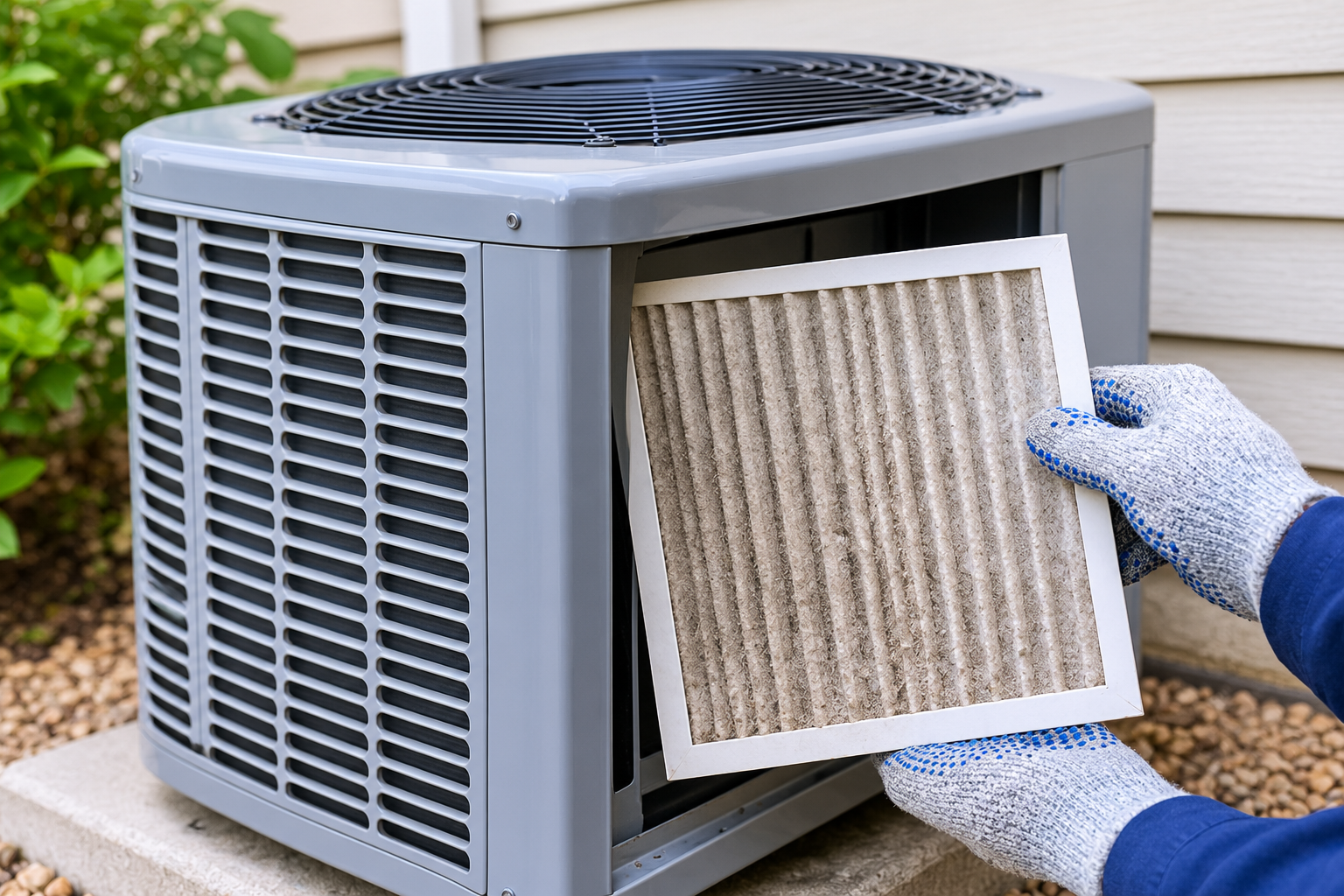
- Replace or clean the air filter, and check it monthly during cooling season.
- Confirm the thermostat is on Cool, set below the room temperature, with fresh batteries.
- Reset a tripped breaker once, and stop if it trips again.
- Clear leaves, grass, and debris so there are at least two feet of space around the outdoor unit.
- Gently straighten bent coil fins with a fin comb, with the power off.
- Clear the condensate drain with a wet/dry vacuum and flush it with white vinegar.
- Gently rinse the outdoor condenser coil with a garden hose (never a pressure washer), with the power off.
A handful of basic tools covers all of this: a screwdriver set, a wet/dry vacuum, a fin comb, a soft brush, and a flashlight. A multimeter is useful for confirming power at the disconnect, but only if you know how to use one safely. Always switch the power off at both the breaker and the outdoor disconnect before touching anything, wear gloves and eye protection, use a stable ladder, and never open or cut into refrigerant lines.
When to Call an HVAC Technician
Short answer: Call a pro for anything involving refrigerant, electrical parts inside the unit, grinding or squealing noises, repeated breaker trips, burning smells, or ice that returns after you've thawed it.
A few other signs mean it's time to stop troubleshooting: the system is blowing warm air even after the basic checks, it cycles constantly, the water leak persists, or the unit is old and the problems keep stacking up. Repairs involving refrigerant, the compressor, or high-voltage components also carry safety and warranty implications, since attempting them yourself can void coverage.
How Much Does Air Conditioning Repair Cost?
Short answer: Most air conditioning repair bills fall between roughly $250 and $700, with a typical visit landing around $375, while major repairs like a compressor or evaporator coil can reach $1,200 to $3,500 or more.
| Repair | Typical Cost | Typical Time |
|---|---|---|
| Diagnostic visit | $75–$250 | 30–60 minutes |
| Capacitor replacement | $100–$400 | 1–2 hours |
| Thermostat replacement | $150–$400 | 1–2 hours |
| Condenser fan motor | $200–$700 | 1–3 hours |
| Blower motor | $400–$900 | 2–4 hours |
| Refrigerant leak repair and recharge | $200–$1,600 | 2–4 hours |
| Evaporator coil | $550–$2,250 | 4–8 hours |
| Compressor replacement | $1,200–$3,500 | 4–6+ hours |
These are national estimates pulled together from several 2026 cost guides, so your actual price will shift with where you live, your system's age and size, and how urgent the call is. Several things push a bill up or down: the diagnostic fee, how expensive the part is, how long the labor takes, whether you're still under warranty, and whether you're calling at 9 a.m. or on a holiday weekend. If a part has to be ordered, the timeline can stretch by a few days. A simple tip that saves money: ask whether the diagnostic fee is credited toward the repair if you approve the work.
Repair or Replace? How to Decide
Short answer: Replacement usually makes more sense when a repair costs more than about half of a new system, when the unit is well into its second decade, or when the problem is a major component or an R-22 refrigerant leak.
A few rules of thumb help here. The 50% rule says to consider replacing if the repair costs more than half the price of a new system. The $5,000 rule multiplies your unit's age by the repair estimate, and if the result tops $5,000, replacement is often the better long-term bet. For example, a 10-year-old system with a $400 repair scores 4,000, so repairing makes sense. A 14-year-old system with an $1,800 compressor scores 25,200, which points firmly toward replacing it.
These are guidelines, not laws. Also weigh the system's age (central AC typically lasts around 15 to 20 years with good care, less in harsh climates), whether you've been paying for repair after repair, whether the unit uses phased-out R-22 refrigerant, and whether your energy bills have been climbing. A newer system will also be noticeably more efficient than one from the early 2000s.
Emergency Air Conditioning Repair
Short answer: If your AC dies during a heat wave, run through the quick checks, then call a company that offers same-day or after-hours service, and expect to pay a premium for the urgency.
Ask about any emergency or after-hours fee up front, and get a price before the work starts. While you wait, protect anyone who's vulnerable to heat, older adults, babies, and pets in particular. Close blinds and curtains, run fans, move everyone to the coolest room, keep water handy, and consider a cooling center or a relative's house if the temperature climbs. Don't attempt electrical or refrigerant repairs in an emergency just to save time.
Types of Air Conditioners and Their Common Problems
Short answer: Central systems have the most parts that can fail, while window, portable, and ductless units each have their own typical issues, and refrigerant or compressor problems on smaller units often make replacement the more practical choice.
Most advice about air conditioning repair assumes a central system, but plenty of homes cool with something else. The basic cooling cycle is the same in every type, so the filter, coil, and drainage problems from earlier in this guide show up everywhere. What changes is how much of the repair you can reasonably handle yourself and whether fixing the unit is worth the money.
Central air conditioners are the most complex, so they have the longest list of things that can go wrong: failed capacitors, refrigerant leaks, frozen coils, clogged drain lines, and worn blower or fan motors. Filters, the condensate drain, and clearing debris from the outdoor unit are all fair game at home. Anything involving refrigerant, electrical parts, or the compressor needs a technician. Because a central system is a large investment, repairing it usually makes sense unless the unit is old or the compressor has failed.
Heat pumps cool the same way a central AC does, so they share the same problems, with one addition. A heat pump uses a reversing valve to switch between cooling and heating, and if that valve sticks or fails, the system may blow the wrong kind of air or stop switching modes. Keep the filter clean and the outdoor unit clear, and leave valve and refrigerant work to a pro.
Ductless mini-splits put an air handler on the wall inside and a compressor outside, connected by refrigerant lines. The most common complaints are dirty indoor filters and coils, clogged condensate drains that cause the indoor unit to drip, and error codes from sensors or the circuit board. You can usually remove and wash the indoor filters and clear the drain yourself, and your owner's manual will explain what the error codes mean. Refrigerant leaks and electronic faults need a technician, and since each unit serves its own zone, a repair affects only that part of the house.
Window units are the simplest and cheapest, and that shapes how you should think about repairs. Typical problems include a dirty filter, clogged drain holes along the bottom of the case, dirty or bent coil fins, and a failed compressor. Cleaning the filter and coils and clearing the drain holes are easy fixes. But if the unit has lost refrigerant or the compressor has died, a repair often costs close to what a new window unit would, so replacing it is usually the smarter move.
Portable air conditioners have a few quirks of their own. Many have an internal water tank that fills up and shuts the unit down, an exhaust hose that has to be sealed tightly to a window kit, and a filter that clogs quickly. If a portable unit suddenly stops cooling, empty the tank, check that the hose is attached and not kinked, and clean the filter before assuming something is broken. As with window units, refrigerant or compressor trouble generally means it's time to replace rather than repair.
How to Choose an AC Repair Company
Short answer: Pick a licensed, insured company whose technicians are EPA-certified for refrigerant, who gives you a written estimate before starting, and who stands behind both parts and labor.
- License and insurance: confirm both, since requirements vary by state and local rules.
- EPA certification: anyone handling refrigerant needs it.
- Written estimates: a clear breakdown of parts, labor, and any fees before work begins.
- Warranty on the work: ask how long the labor and parts are covered.
- Reviews: look for consistent patterns about punctuality, honesty, and follow-through rather than a handful of glowing ones.
- Second opinion: for any repair over a thousand dollars or a recommendation to replace the whole system, it's reasonable to get another quote.
Be cautious about rock-bottom bids, pressure to decide on the spot, or a company that recommends a refrigerant "top-off" without explaining where the leak is.
How to Prevent Air Conditioning Repairs
Short answer: Change filters on schedule, keep the outdoor unit clear, flush the drain line, and book one professional tune-up each spring before cooling season starts.
Regular maintenance won't prevent every breakdown, but it catches many of the problems in this guide while they're still small, dirty coils, a slow drain, a weakening capacitor, a minor refrigerant loss. A tune-up typically includes checking refrigerant levels, testing electrical components, cleaning coils, and inspecting the drain, and it's a routine our HVAC maintenance checklist lays out by what to do monthly, seasonally, and annually.
Frequently Asked Questions
How much does air conditioning repair cost?
Most repairs run between $250 and $700, with a national average around $375. Small fixes like a capacitor or thermostat typically cost $100 to $400, while a compressor or evaporator coil can cost $1,200 to $3,500 or more.
Why is my air conditioner running but not cooling?
The most common reasons are a clogged filter, a dirty or frozen coil, low refrigerant from a leak, or a failed capacitor or compressor. Check the filter and thermostat first, then call a technician if the air is still warm.
How long does AC repair take?
Minor repairs such as a capacitor or thermostat usually take one to two hours. Refrigerant leaks and motor replacements run two to four hours, and compressor or coil replacements can take four to six hours or more, longer if parts have to be ordered.
Can I repair my air conditioner myself?
You can safely handle filters, thermostat settings, debris around the outdoor unit, and a clogged condensate drain. Refrigerant, capacitors, compressors, and any wiring inside the unit should go to a licensed technician.
How often should an air conditioner be serviced?
Once a year is the standard recommendation, ideally in spring before you need the system. Filters need attention far more often, usually every one to three months during cooling season.
Does regular maintenance prevent AC breakdowns?
It prevents many of them. Clean filters, clear drains, and a yearly tune-up catch the issues that most often turn into repairs, though age and normal wear can still cause failures that no amount of upkeep can fully avoid.
Final Thoughts
Good air conditioning repair starts with paying attention to what your system is telling you: warm air, strange noises, ice, water, or a bill that keeps climbing. Handle the simple checks yourself, bring in a licensed technician for refrigerant, electrical, and compressor problems, and use the repair-or-replace rules before approving an expensive fix on an older unit. If you want to keep the rest of the house on a similar routine, our monthly home maintenance checklist covers the other systems that tend to be ignored until they fail.