

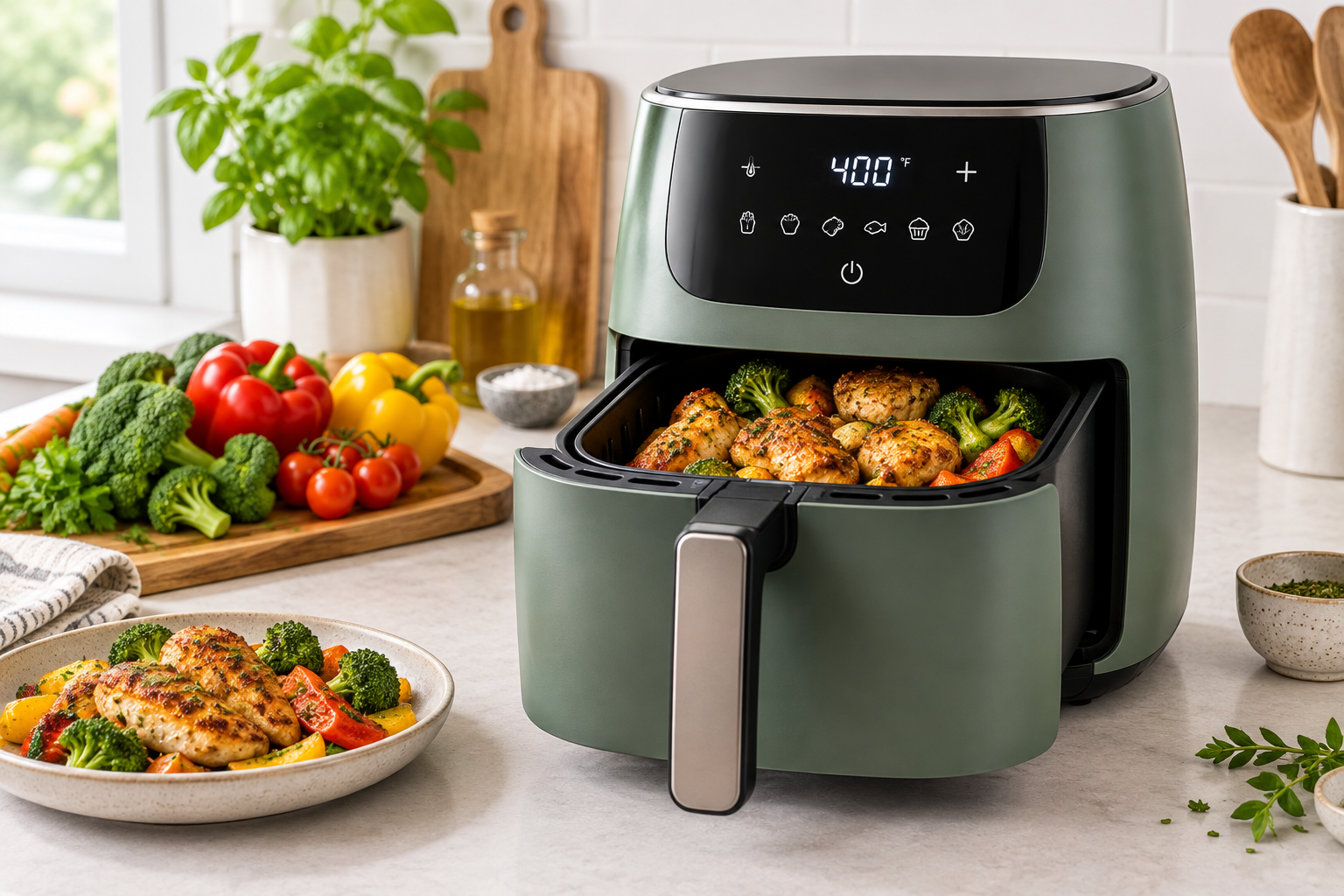
Short answer: The safest non toxic air fryer picks use ceramic, glass, or stainless steel on every food-contact surface instead of a PTFE (Teflon) coating. The ten models below, from Cosori, Ninja, Typhur, GreenPan, Our Place, Cuisinart, Fritaire, Instant, Philips, and Breville, were chosen specifically because their actual materials can be verified rather than just marketed.
Introduction
Most air fryers on shelves today still rely on a Teflon-style nonstick coating, which is fine at normal cooking temperatures but can break down and release fumes if it's ever scratched, overheated, or simply worn out after a couple of years. The good news is that genuinely safer options now exist across every price point and style, basket, oven, and glass dome alike. Below, we break down what actually makes a material safe, ten specific picks worth considering, and how to double check any brand's claims yourself before you buy.
| Pick | Material | Price | Best For |
|---|---|---|---|
| Cosori TurboBlaze | PFAS-free ceramic | $99.99 | Best value ceramic |
| Typhur Sync | PFAS-free ceramic | $199.99 | Built-in temp probe |
| Typhur Dome 2 | PFAS-free ceramic | $390 | Large families |
| GreenPan Bistro 9-in-1 | PFAS-free ceramic | $189 | Independently certified |
| Instant Vortex VersaZone | PFAS-free ceramic | ~$239.99 | Dual-zone cooking |
| Fritaire Self-Cleaning | Glass | $199.99 | Full glass air fryer |
| Ninja Crispi Pro | Glass + ceramic plates | $249.90 | Cook-to-storage glass |
| Cuisinart ClearView | Glass + ceramic plate | $139.95 | Small households |
| Our Place Wonder Oven | Glass + stainless steel | $185 | Light, versatile oven |
| Ninja Crispi Microwave Combo | Stainless steel + glass | $399.99 | 2-in-1 appliance |
Are Air Fryers Actually Toxic?
Air fryers themselves aren't inherently dangerous, but a specific set of materials used in many of them can be. The concern centers on PTFE (sold under the brand name Teflon), a nonstick polymer that can release irritating fumes if it's heated above roughly 500°F or if the coating is scratched and breaking down. PTFE belongs to a larger family of PFAS chemicals, sometimes called "forever chemicals" because they persist in the environment for an extremely long time, and specific PFAS compounds like PFOA have been classified by the International Agency for Research on Cancer as carcinogenic to humans. Most manufacturers today keep their nonstick coatings PFOA-free, but that doesn't mean a coating is free of PFAS entirely, which is why checking for a specific, named material (ceramic, glass, stainless steel) matters more than a vague "healthy coating" label on the box.
There's a second, separate concern worth knowing about: acrylamide, a compound that forms in starchy foods cooked at high heat by any method, frying, toasting, or air frying alike. It's why you'll see Prop 65 warnings on nearly every air fryer sold in California. The risk from typical home cooking is considered low, but cooking at lower temperatures and avoiding heavy browning or charring reduces it further.
What Makes an Air Fryer Non-Toxic?
The safest non toxic air fryer options rely on one of three food-contact materials instead of a fluoropolymer coating:
- Ceramic. A sand-derived, sol-gel coating sprayed onto a metal basket. It avoids PFAS entirely, tolerates high heat without breaking down, and often cooks a bit more evenly, though it needs gentler care than metal alone (soft sponges, no metal utensils) and tends to cost more than standard nonstick.
- Glass. A glass air fryer basket has no coating to wear out or scratch in the first place, since there's nothing on the surface to begin with. It also lets you watch food cook in real time, which is genuinely useful for catching something before it burns. The tradeoffs are weight, fragility if dropped, and a basket that gets hot to the touch.
- Stainless steel. A stable, non-reactive, corrosion-resistant metal that doesn't leach chemicals into food, used either as an uncoated mesh basket or as the interior of an oven-style unit. It generally needs a bit more oil to prevent sticking than ceramic or a nonstick coating would.
A fourth, increasingly common option is the hybrid, an oven-style appliance that combines a stainless steel interior with glass or ceramic-coated trays and racks, giving you the benefits of more than one material in a single unit.
10 Best Non-Toxic Air Fryers
Ceramic Picks
Cosori TurboBlaze 6-Quart Air Fryer uses a PFAS-free ceramic coating across a 6-quart basket with nine cooking functions, and at under $100, it's consistently the best value entry point into ceramic air frying. Cosori has also released a newer version with a fully stainless steel interior for anyone who'd rather skip coatings entirely.
Typhur Sync pairs a PFAS-free ceramic-coated metal basket with a built-in wireless temperature probe, which takes the guesswork out of cooking meat to a precise finish. It's compact for its 8-quart capacity and dishwasher-safe, though it doesn't include a dedicated toast function.
Typhur Dome 2 is the largest ceramic air fryer most reviewers have tested, wide enough to fit a 12-inch pizza, with 15 cooking modes and a PFAS-free ceramic crisper plate. It's genuinely expensive, but it can realistically replace an oven, toaster, and grill for a larger household.
GreenPan Bistro 9-in-1 Air Fryer Toaster Oven stands out for transparency as much as the cooking itself. GreenPan owns its own factories and has its proprietary sand-derived ceramic coating independently tested and certified against FDA, German LFGB, Swiss, and KTR safety standards, a level of third-party verification few competitors in this list can match.
Instant Vortex VersaZone splits a 12-liter PFAS-free ceramic-coated basket into two independently controlled cooking zones. Worth knowing: Instant's own older Vortex Plus line uses a standard PTFE coating, so if you're shopping this brand, confirm you're looking at the newer VersaZone or Vortex Dual models specifically, not an older listing.
Glass Picks
Fritaire Self-Cleaning Air Fryer is a full glass air fryer with a rotating tumbler basket and a separate rotisserie attachment, confirmed BPA, Teflon, and PFAS-free. The transparent bowl lets you watch food cook and stop it before it burns, though the lid runs hot and the rotisserie motor feels less sturdy than the rest of the unit.
Ninja Crispi Pro uses interchangeable borosilicate glass containers with BPA-free plastic handles and a ceramic-coated, PFAS-free crisper plate, confirmed by SharkNinja as 100% PFAS-free. The containers double as fridge-safe storage with included lids, a genuinely useful detail for meal prep.
Cuisinart ClearView Glass Basket Air Fryer is a compact 4-quart glass air fryer best suited to one or two people, with a PFAS-free ceramic crisper plate and a basket lid for easy transfer to the fridge. A built-in light makes it easy to check on food without opening the drawer.
Our Place Wonder Oven combines premium glass and stainless steel construction, confirmed free of PTFE, PFOA, PFAS, lead, and cadmium. It's an oven-style unit best suited to a one or two person household given its size, with a steam-infusion feature that keeps food from drying out.
Stainless Steel Picks
Ninja Crispi Microwave & Air Fryer combines a stainless steel microwave interior with a glass air fryer basket and a PFAS-free ceramic crisper tray, replacing two countertop appliances in one. It's large, so it's worth measuring your counter space before committing, but the combination of functions is hard to match elsewhere on this list.
A note on two other popular names: Philips and Breville both sell air fryers, but neither has a single, clearly PFAS-free flagship the way the brands above do. Philips' own support documentation confirms that most of its Airfryer baskets and trays use a PTFE-based nonstick coating, with only select models (like certain 7000 Series units) using ceramic instead, so the model number matters enormously if you're shopping this brand. Breville's popular Smart Oven Air Fryer Pro uses an uncoated stainless steel mesh basket, which is genuinely safe, but some of its included accessories (like the pizza pan) have shipped with a nonstick coating on different production runs without a company-wide PFAS-free certification. If you go with either brand, stick to the bare stainless steel components and verify the specific model and accessory before assuming the whole unit is coating-free.
How to Verify a Brand's Non-Toxic Claims
Marketing language varies a lot, and not every term means the same thing. "PFOA-free" only rules out one specific legacy chemical, not the whole PFAS family. "Teflon-free" just means the coating isn't sold under that brand name, it could still be a different PTFE or PFAS formula. The claim worth actually trusting is "PFAS-free," paired with a named, specific material like ceramic, glass, or stainless steel rather than a vague term like "healthy coating" or "eco coating." It's also worth checking that any ceramic coating is confirmed free of lead and cadmium, since those are separate concerns from PFAS entirely. When in doubt, check the brand's own product specifications page or contact support directly, several manufacturers (including the ones flagged above) will confirm the exact material composition if you ask.
Tips to Reduce Chemical Exposure When Air Frying
A few habits matter regardless of which material you choose. Avoid aerosol cooking sprays that contain lecithin, an emulsifier that gradually breaks down nonstick coatings faster than oil applied directly would, brushing or misting a small amount of avocado or olive oil works just as well. Use wood or silicone utensils rather than metal, since scratches are what expose a coating to further breakdown. Hand wash ceramic-coated parts with a soft sponge instead of the dishwasher when possible, since repeated high heat accelerates wear. And if a coating ever starts flaking, chipping, or peeling on any air fryer, stop using that basket regardless of what it's made of.
Frequently Asked Questions
Are nonstick air fryers safe?
A PTFE-based nonstick coating is considered safe under normal use, but it can release irritating fumes if overheated above roughly 500°F or if the coating is damaged. Ceramic, glass, and stainless steel avoid this concern because they don't rely on that type of coating at all.
What is the safest material for an air fryer?
Glass and stainless steel are the most inherently safe since there's no coating to wear down or scratch in the first place. PFAS-free ceramic is a close third, genuinely safe when it's confirmed PFAS, lead, and cadmium-free, though it needs gentler cleaning than bare metal or glass.
Does air frying release toxic chemicals into food?
Properly functioning, undamaged cookware of any of these materials does not meaningfully leach chemicals into food under normal cooking temperatures. The risk rises specifically with a scratched or overheated PTFE coating, which is the scenario non-toxic materials are designed to avoid entirely.
Which brand makes the best glass air fryer?
Fritaire and Ninja's Crispi Pro are the strongest full glass options on this list, Fritaire for its rotating tumbler basket and rotisserie function, and the Crispi Pro for its interchangeable, fridge-safe glass containers.
Is a PFAS-free label always accurate?
Not automatically, but it's the most trustworthy single term available. Confirm it's paired with a specific named material (ceramic, glass, stainless steel) rather than a vague marketing phrase, and check the brand's own specifications page if you want to verify it yourself.
Conclusion
The honest takeaway is that a non toxic air fryer isn't really about chasing one specific brand name, it's about confirming the exact food-contact material before you buy, since even well-known brands sell a mix of coated and uncoated models side by side. Ceramic gives you the closest experience to traditional nonstick without the PFAS, glass lets you watch your food cook with nothing to wear out, and stainless steel is about as close to a permanently safe surface as a kitchen appliance gets. Whichever material you lean toward, checking the specific model's actual specifications beats trusting the phrase on the box every time.