

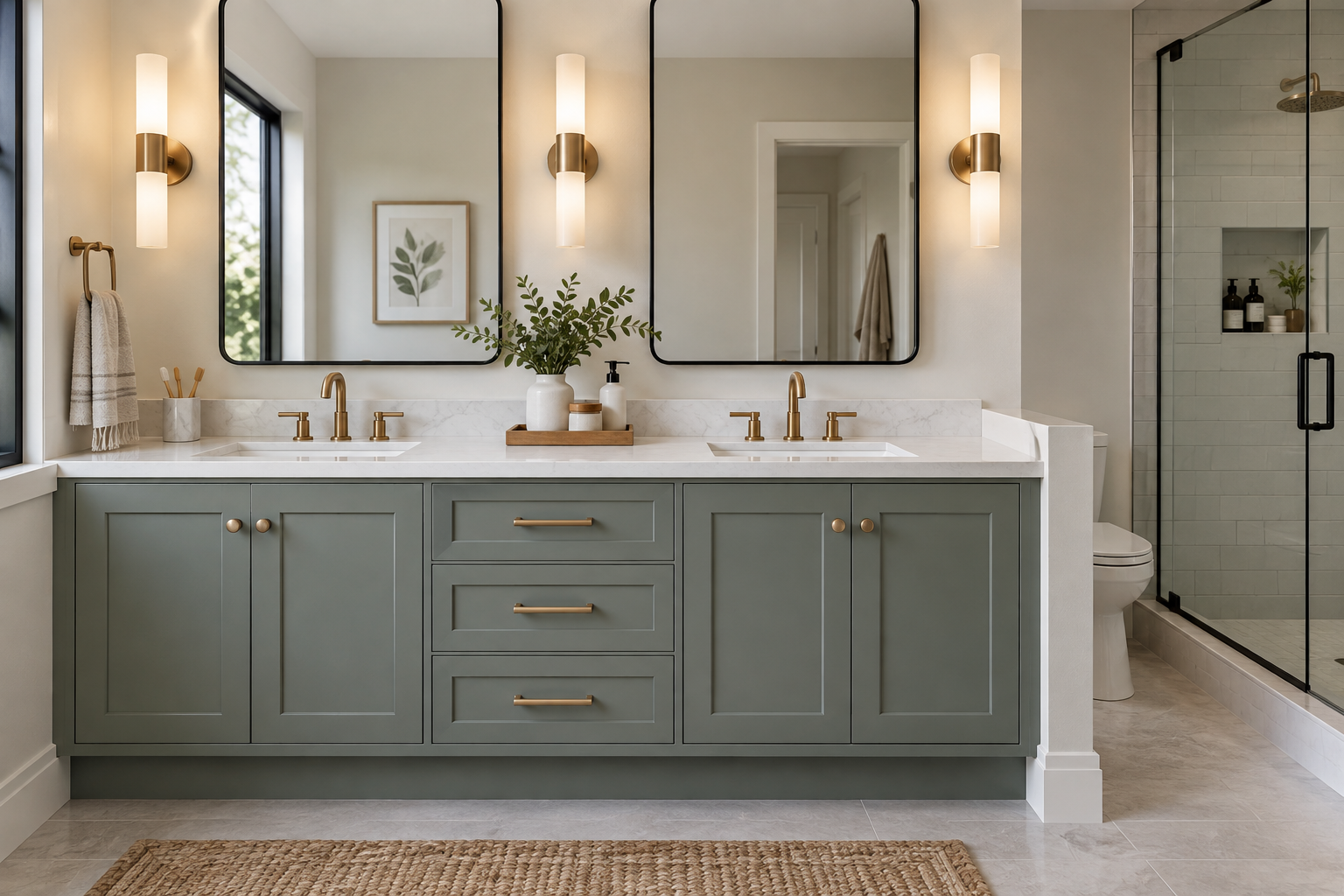
Introduction
A bathroom vanity does more work than almost any other single piece in the house, it holds the sink, hides the plumbing, gives you counter space to actually get ready in the morning, and usually carries most of the room's storage on its shoulders. Picking the wrong one means living with a cramped countertop or a cabinet that never quite fits what you own, while picking the right one solves a dozen small daily annoyances at once. This guide walks through every major type of bathroom vanity, the sizes that actually work for different bathrooms, the styles worth knowing, and the materials that hold up (or don't) in a room that's wet more often than any other in the house.
| Type | Best For | Storage | Typical Install |
|---|---|---|---|
| Freestanding | Primary and guest baths | Excellent | DIY-friendly |
| Floating (wall-mounted) | Small or modern baths | Good | Professional recommended |
| Pedestal | Powder rooms, half-baths | None | Moderate |
| Console | Guest baths wanting an open look | Limited | Moderate |
| Vessel sink | Statement or spa-style baths | Good | DIY-friendly |
| Undermount | Modern, easy-clean baths | Good | Professional recommended |
| Corner | Tiny or awkward layouts | Limited | Moderate |
| Double sink | Shared primary baths | Excellent | Professional recommended |
What Is Bathroom Vanity?
Short answer: A bathroom vanity is the combination of a cabinet, a countertop, and a sink (or two) that anchors the room, hides the plumbing underneath, and provides most of the bathroom's storage and counter space.
The term covers a wide range of bathroom vanity cabinet styles, from a simple pedestal with almost no storage to a full furniture-style cabinet with drawers, a mirror, and a backsplash built to match. Most vanities include a few consistent parts: the cabinet base, a countertop (often with an integrated or separately mounted sink), a faucet, drawers or doors for storage, and hardware like knobs or pulls. Some also include a matching mirror or medicine cabinet above, though that's typically sold and installed separately.
Types of Bathroom Vanities
Short answer: The main types are freestanding, floating, pedestal, console, vessel sink, undermount, corner, and single or double sink configurations, and the right one depends mostly on your available space and how much storage the room needs.
Freestanding Vanities
A freestanding bathroom vanity sits directly on the floor like a traditional piece of furniture, and it remains the most common choice for primary and guest bathrooms because it offers the most storage for the price. Furniture-style freestanding vanities, with decorative legs and a more finished, standalone look, have become especially popular over the past few years as an alternative to boxy, built-in-looking cabinets.
Floating (Wall-Mounted) Vanities
A floating bathroom vanity, also called a wall mounted bathroom vanity, attaches directly to the wall with no floor contact at all. This creates an open, airy look and makes mopping the floor dramatically easier, but it needs to be anchored into wall studs (or blocking installed specifically for it) to safely hold weight over time, which is why professional installation is usually the safer call here. It's a strong pick for small bathrooms where visible floor space genuinely makes the room feel bigger.
Pedestal and Console Vanities
A pedestal sink is a basin mounted on a slim column with essentially zero storage, which makes it the go-to choice for powder rooms and half-baths where storage isn't really the point. A console vanity is a step up, a sink basin on a metal or wood frame that usually includes a lower shelf for towels, offering a bit more function while keeping the same open, uncluttered look.
Vessel Sink and Undermount Vanities
A vessel sink sits entirely above the countertop as a decorative bowl, creating a dramatic focal point, but it requires a taller faucet and a slightly lower cabinet to keep the rim at a usable height. An undermount sink vanity mounts the basin beneath the countertop for a seamless, easy-to-wipe-down surface, which is why it's become the standard choice in most modern bathroom designs. A drop-in sink, which sits in a cutout with its rim resting on top of the counter, remains the simplest and most budget-friendly option of the three.
Corner Vanities
A corner vanity uses a triangular or L-shaped cabinet built specifically for a 90-degree corner, reclaiming space that would otherwise sit empty in a tight or awkwardly shaped bathroom. It sacrifices some storage capacity compared to a straight-wall cabinet of the same width, but in a genuinely small bathroom, it's often the only way to fit a vanity without blocking the door or shower.
Single vs. Double Bathroom Vanities
Short answer: A single vanity offers more counter space per person and costs less to install, while a double vanity lets two people get ready at once but needs at least 60 inches of width to actually work well.
| Single Vanity | Double Vanity |
|---|---|
| More usable counter space per sink | Two people can use it at once |
| Lower cost, simpler plumbing | Roughly double the plumbing and fixture cost |
| Works in bathrooms as narrow as 24 inches | Needs 60 inches of width minimum |
| Best for guest baths and single users | Best for shared primary bathrooms |
A double bathroom vanity genuinely earns its extra cost when two people actually get ready at the same time on a regular basis. Below that 60-inch threshold, splitting the space into two smaller basins usually means less counter space and storage than a single wider vanity would have offered, so a single bathroom vanity in a generous width is often the more practical choice for a bathroom used by just one person.
Bathroom Vanity Sizes and Dimensions
Short answer: Standard single vanities run from 24 to 48 inches wide, double vanities start around 60 inches, and comfort height (34 to 36 inches) has become the modern standard for countertop height.
Getting the size right matters more than almost any style decision, since a vanity that's even a couple of inches too wide can block a door swing or crowd a shower entry. Here's how the standard bathroom vanity dimensions break down:
| Width | Typical Use |
|---|---|
| 18–24 inches | Powder rooms, very small half-baths |
| 30–36 inches | Guest bathrooms, standard single vanities |
| 42–48 inches | Primary bathrooms wanting extra counter space |
| 60 inches | Entry-level double sink vanity |
| 72 inches | Full-size double vanity, most comfortable per-person space |
Beyond width, a few other numbers matter just as much. Standard depth runs 20 to 24 inches, with 16 to 18-inch options available for especially tight spaces. Comfort height (34 to 36 inches) has become the modern default because it reduces back strain during everyday use, closer to kitchen counter height, while the traditional 30 to 32-inch height still makes sense for kids' bathrooms or vanities paired with a tall vessel sink. Building codes generally call for at least 21 inches of clear floor space in front of the vanity, with 30 inches recommended if you want real comfort rather than the bare minimum.
Bathroom Vanity Styles
Short answer: Popular bathroom vanity styles range from clean-lined modern and Scandinavian looks to warmer farmhouse and traditional designs, and the right one usually follows whatever style the rest of the bathroom is already leaning toward.
Modern and Contemporary Bathroom Vanities

A modern bathroom vanity favors flat-front cabinet doors, minimal hardware, and a neutral palette, often paired with a floating installation and an undermount sink for the cleanest possible look. Contemporary bathroom vanity styles are similar but evolve with current trends, currently leaning toward warm wood tones and fluted or ribbed cabinet fronts rather than the all-white, high-gloss look that dominated a decade ago.
Farmhouse Bathroom Vanities
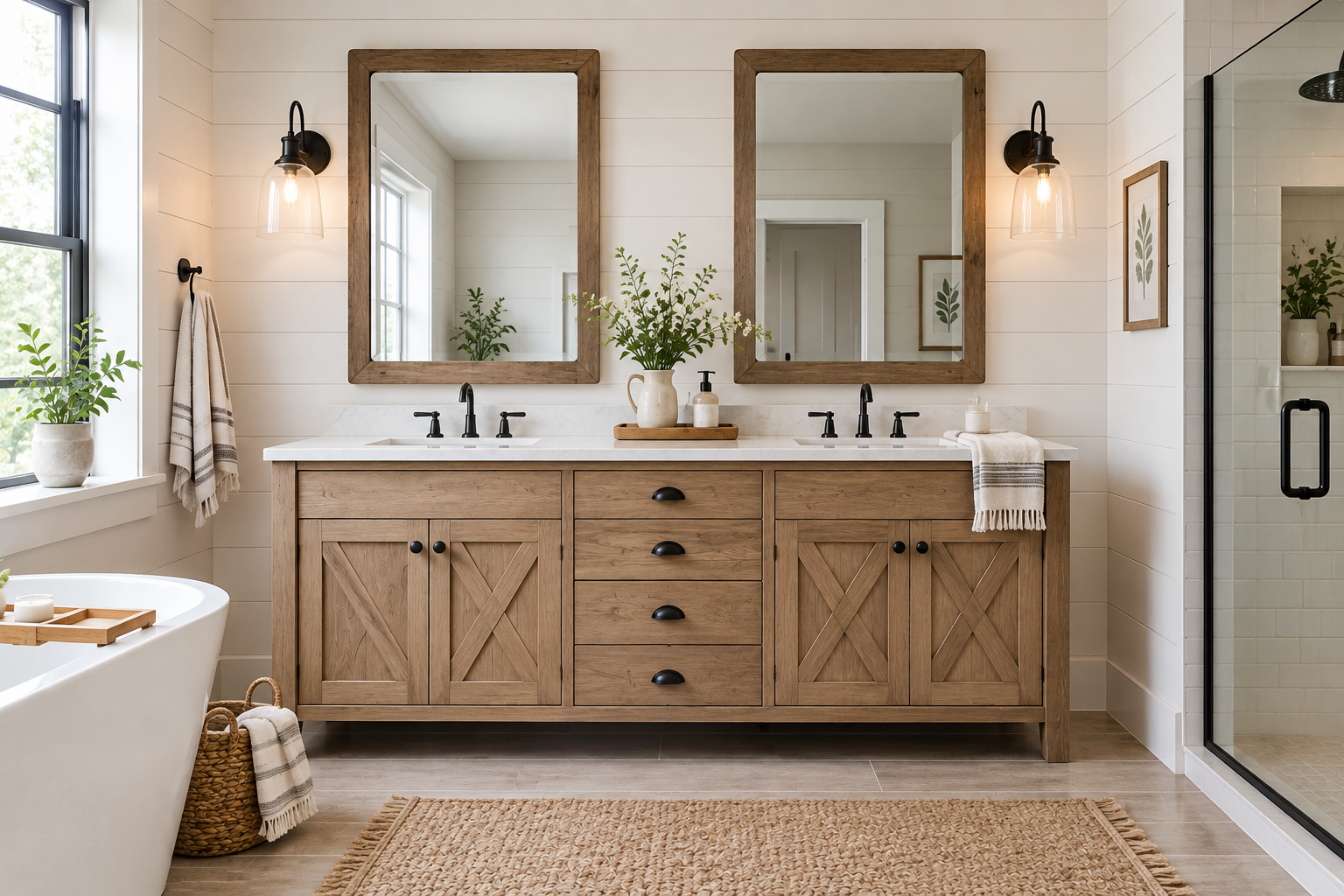
A farmhouse bathroom vanity combines a mostly white or soft neutral cabinet with black metal hardware and a slightly distressed or shaker-style door front. It pairs naturally with a vessel sink or an apron-style basin and remains one of the most consistently searched bathroom vanity ideas because it photographs well and works in both older and newer homes.
Traditional and Transitional Vanities
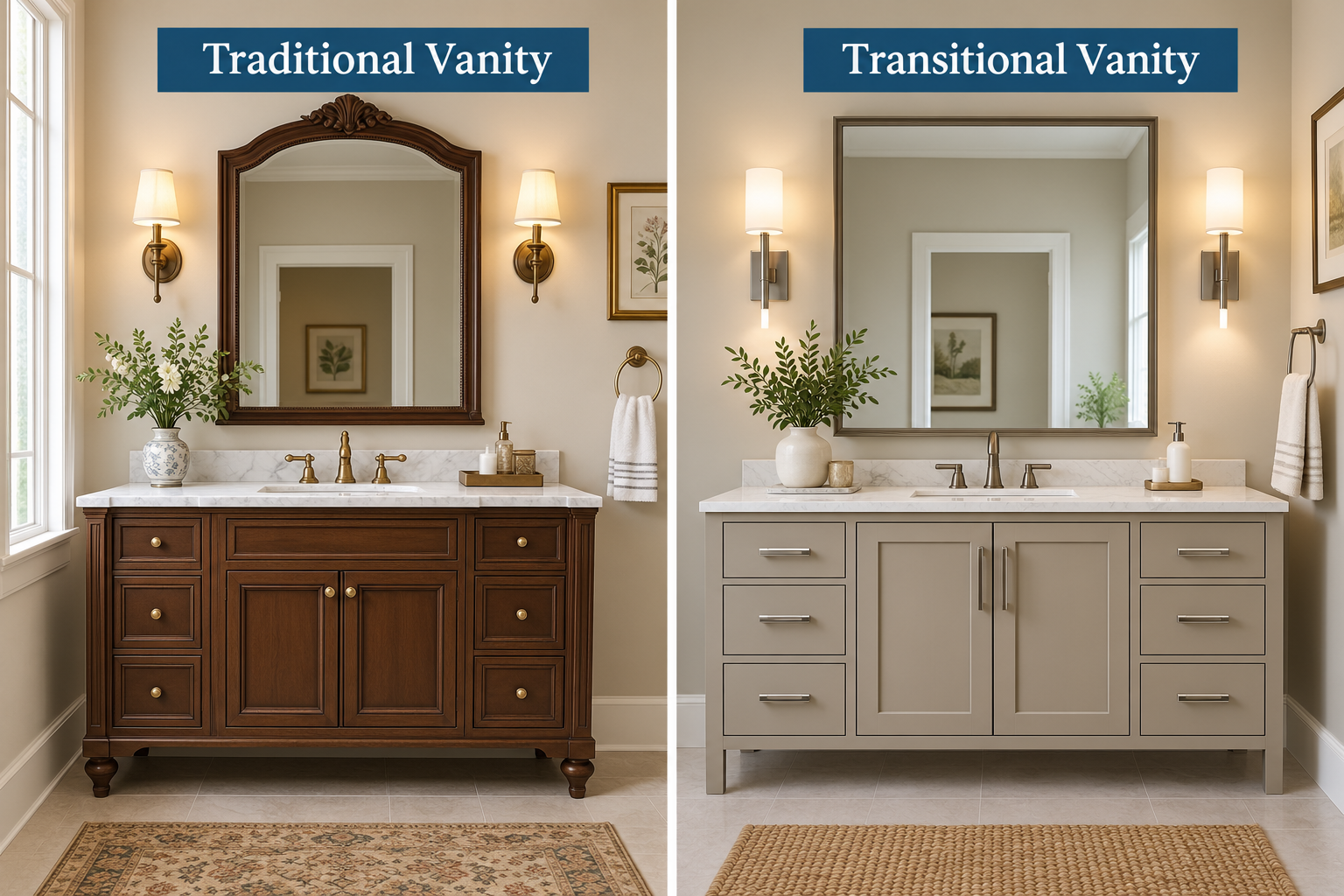
Traditional vanities lean into rich wood tones, raised-panel doors, and furniture-style details like turned legs or crown molding along the top. Transitional vanities split the difference, keeping a classic silhouette but simplifying the door style and hardware for a cleaner, more current feel, which makes this one of the more forgiving styles to pair with an older bathroom that isn't getting a full renovation.
Minimalist and Scandinavian Vanities
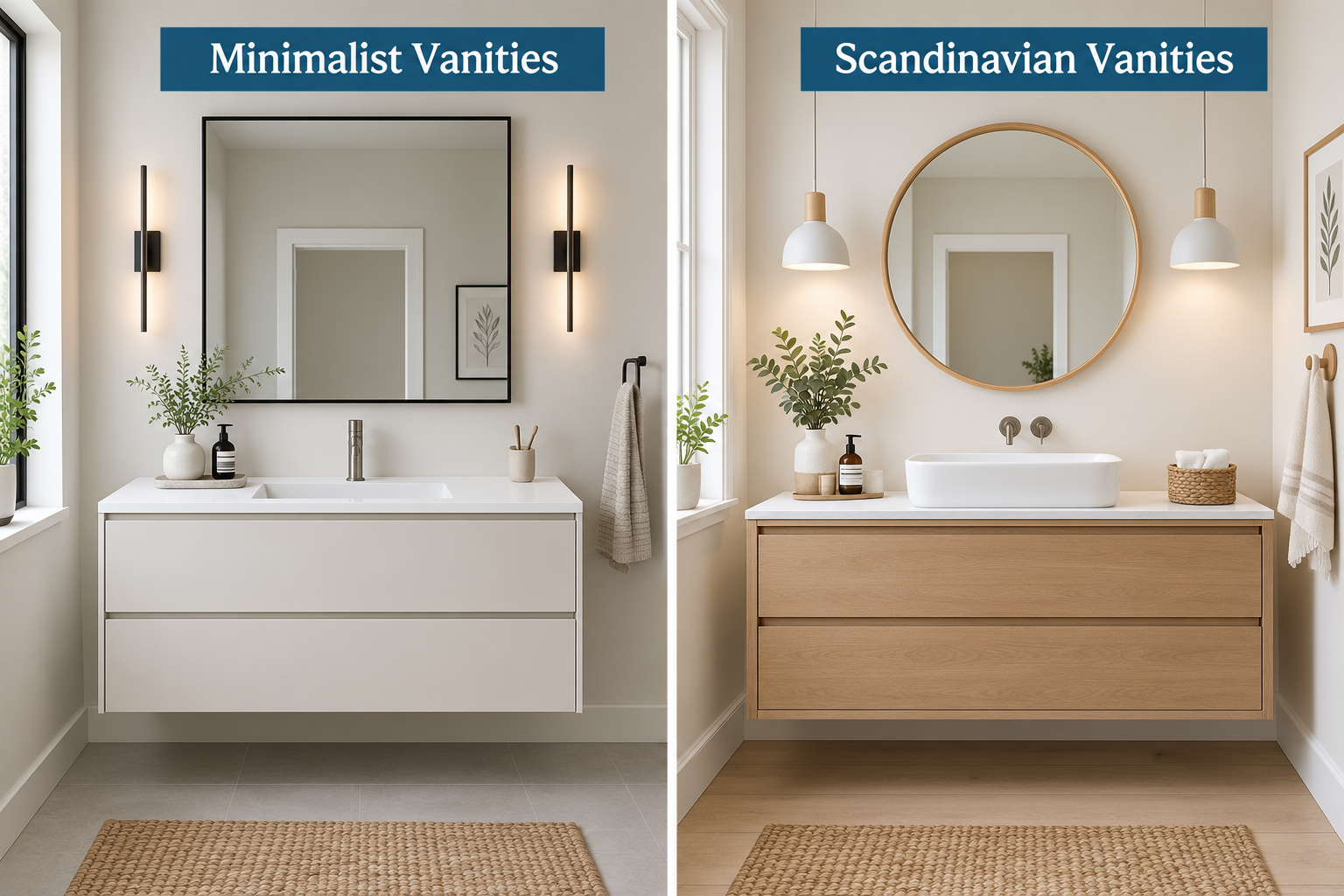
A minimalist bathroom vanity strips the design down to flat panels, hidden hardware, and a tightly restrained color palette, usually just one or two neutral tones total. Scandinavian styling softens that same restraint with light wood tones and simple, rounded hardware, avoiding the slightly cold feel a pure minimalist cabinet can sometimes have.
Industrial and Mid-Century Modern Vanities
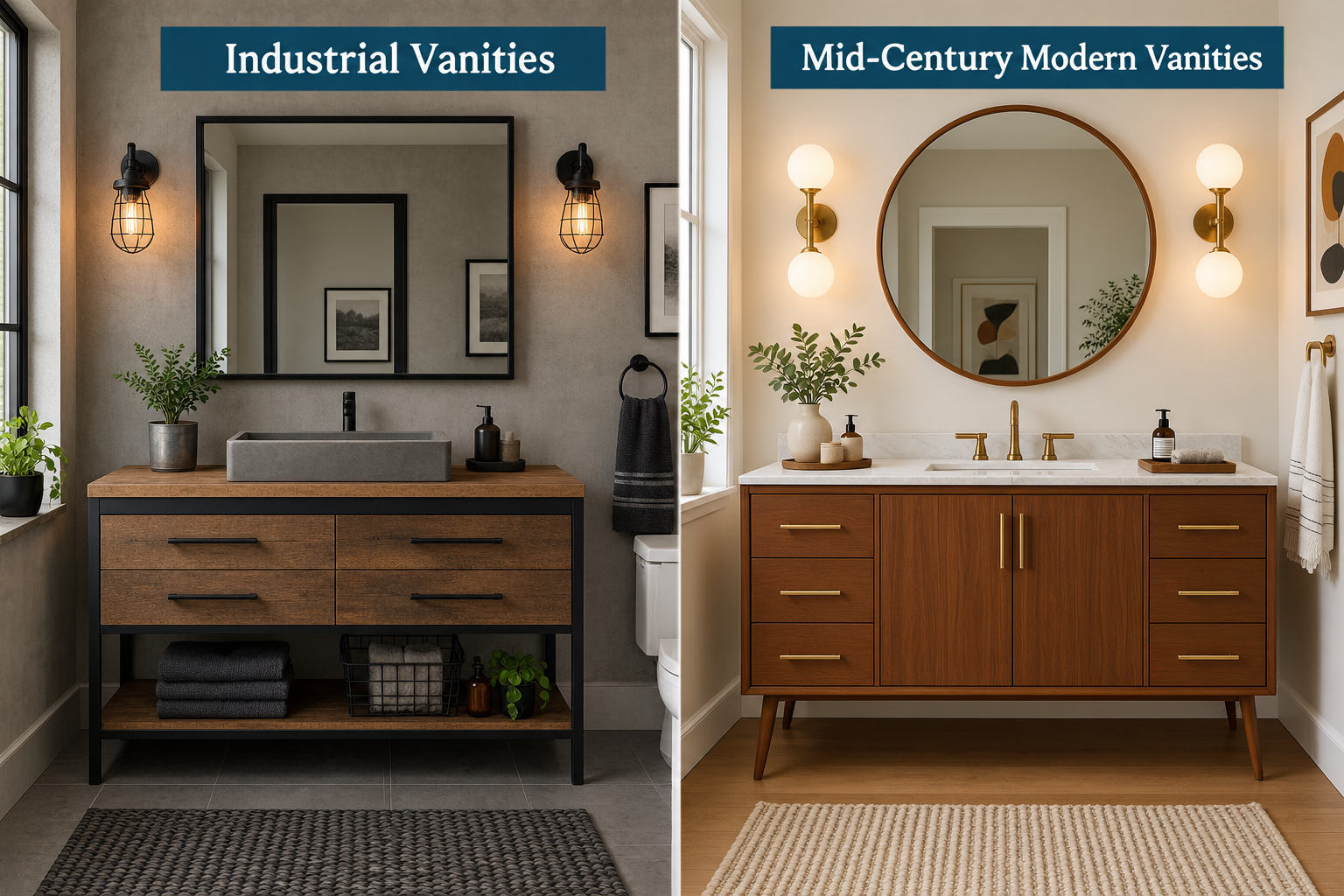
Industrial-style vanities favor raw materials, exposed metal legs, concrete-look countertops, and black hardware against a darker cabinet finish. Mid-century modern vanities bring in warm walnut tones and tapered legs, echoing the same furniture silhouettes popular in mid-century living rooms, and they tend to pair especially well with a vessel sink sitting on top.
Coastal, Vintage, and Luxury Vanities
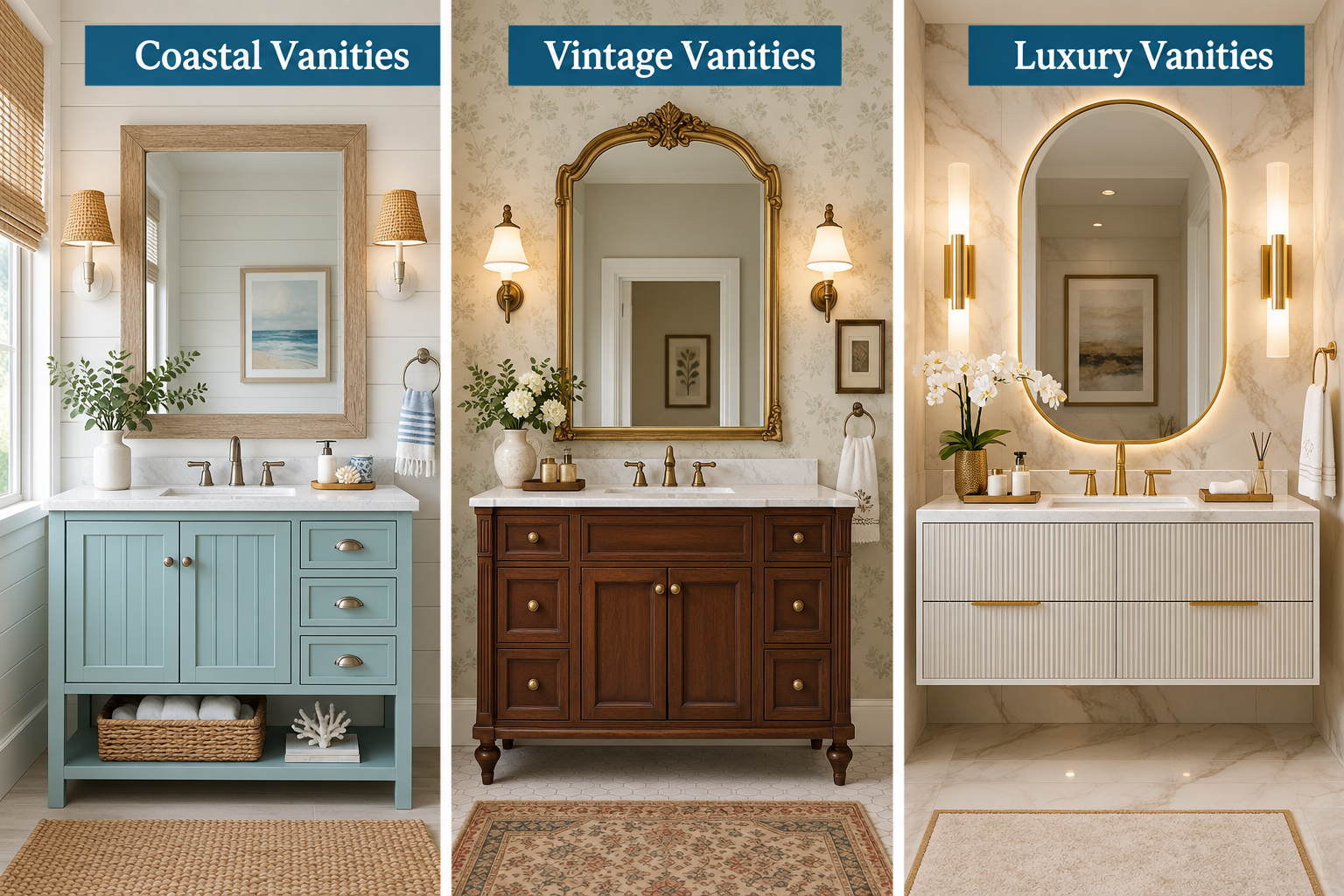
Coastal vanities lean into light woods, white or soft blue cabinet colors, and woven or rope-style hardware for a relaxed, beach-adjacent feel. Vintage and shabby chic vanities repurpose or replicate older furniture pieces, often with visibly worn or painted finishes. At the top end, a luxury bathroom vanity or custom bathroom vanity typically combines solid wood construction, a natural stone countertop, and integrated features like built-in lighting or a smart mirror, priced well above anything sold pre-made off the shelf.
Bathroom Vanity Materials
Short answer: Plywood is the most reliable cabinet material for a humid bathroom, while quartz remains the most practical countertop choice for its combination of durability and zero required sealing.
Cabinet Materials
| Material | Pros | Cons | Best Use |
|---|---|---|---|
| Solid wood (oak, walnut, maple, cherry, teak) | Strong, refinish able, long lifespan | Most expensive, can warp with heavy moisture | Face frames, doors, legs |
| Plywood | Moisture resistant, stable, strong | Mid-range cost | Cabinet boxes (generally the best choice) |
| MDF | Smooth for painted finishes, affordable | Swells permanently if water penetrates | Painted door fronts only |
| Particle board | Cheapest available | Crumbles with sustained moisture exposure | Best avoided in bathrooms entirely |
Solid wood species each bring a slightly different look and price point: oak shows a pronounced grain and holds up well, walnut brings a deep, warm brown tone at a higher price, maple offers a smoother, more uniform grain that takes paint well, and cherry and teak both darken attractively with age, with teak carrying natural water resistance that makes it a strong choice for a genuinely wet environment.
Countertop Materials
| Material | Porous | Sealing Needed | Heat Resistance |
|---|---|---|---|
| Quartz (engineered) | No | Never | Moderate |
| Granite | Low | Occasionally | High |
| Marble | High | Regularly | High, but stains easily |
| Laminate | Low | Annually | High |
| Solid surface | No | Never | Moderate |
| Laminate | No | Never | Low |
Quartz has become the default recommendation for good reason, it never needs sealing, resists staining better than natural stone, and comes in a wide enough range of colors to match nearly any style on this list. Marble looks beautiful and pairs especially well with traditional and luxury styles, but it etches from everyday products like toothpaste and perfume, so it demands more regular care than most homeowners expect going in.
How Much Storage Do You Actually Need?
Short answer: Match your storage to how many people share the bathroom and what you actually need to keep in it, drawers generally outperform a single cabinet door for everyday usability.
A bathroom vanity with storage genuinely worth the name usually prioritizes drawers over a single open cabinet, since drawers give full access to everything inside instead of forcing you to dig past items stacked in front. Deep drawers work well for hair tools and larger items, while a shallow top drawer suits daily essentials like toothbrushes and skincare. Underestimating drawer space is one of the most common regrets homeowners report after a vanity purchase, so it's worth erring toward more storage than you think you'll need, especially in a shared or double vanity setup.
How Much Does a Bathroom Vanity Cost?
Short answer: A prefabricated vanity typically runs $100 to $2,600 before installation, while a fully custom vanity starts around $500 and can exceed $4,000 installed.
| Configuration | Unit Cost | Installed Cost |
|---|---|---|
| Prefabricated single vanity | $100–$2,600 | $400–$1,700 |
| Custom-built vanity | $500–$3,000 | $1,000–$4,000+ |
| 60" double sink vanity | $550–$1,900 | $700–$2,200 |
| 72" double sink vanity | $600–$2,200 | $1,100–$2,500 |
Material choice drives most of the price swing within each category, a plywood-box vanity with a laminate top sits at the low end, while solid wood construction with a natural stone countertop pushes toward the top. Installation cost also climbs if the plumbing needs to move or if you're switching from a floor-mounted to a floating vanity, since that typically requires opening the wall to reroute the drain.
How to Choose the Right Bathroom Vanity for Your Space
Short answer: Start with your available space and plumbing, then move to storage needs, and only choose the style and finish last.
It's tempting to shop by style first, but that's how homeowners end up with a beautiful vanity that doesn't actually fit. Measure the full width, depth, and height of the space first, and check clearances around the door swing, shower door, and toilet before you fall in love with a specific size. From there, decide honestly between a single bathroom vanity and a double bathroom vanity based on how many people actually use the room at once, not how many people theoretically could. Prioritize drawer storage over doors where possible, choose a moisture-resistant material for both cabinet and countertop, and confirm the new vanity's plumbing cutout will actually align with your existing drain and supply lines before you order anything. Style, finish, and hardware are the easiest and cheapest details to get wrong and fix later, so they belong at the end of the decision, not the start (if you're planning the vanity as part of a bigger project, our guide to bathroom remodel ideas covers how it fits into the rest of the room).
Installing and Maintaining a Bathroom Vanity
Short answer: A simple freestanding swap with no plumbing changes is manageable as a DIY project, but floating vanities and anything involving moved plumbing are worth handing to a professional.
Installation difficulty varies a lot by type. Swapping a freestanding vanity for one of the same footprint, using the existing plumbing connections, is realistic for a confident DIYer over a weekend. A floating vanity needs to be anchored into studs or blocking rated for its weight, which is a job worth hiring out to make sure it's genuinely secure. Day to day, the biggest maintenance factor is simply keeping standing water off the cabinet and countertop, wiping up splashes quickly, running the bathroom fan to control humidity, and resealing a natural stone top periodically all go a long way toward keeping a vanity looking new for years instead of months.
Common Mistakes When Choosing a Bathroom Vanity
- Measuring the vanity but not the clearances around it, which can mean a perfectly sized cabinet that still blocks a door or drawer from opening fully.
- Choosing MDF for the cabinet box instead of plywood, since MDF swells permanently once water gets past the surface finish.
- Underestimating drawer space, especially in a double vanity shared by two people with very different storage needs.
- Picking style before confirming plumbing compatibility, which can turn a simple swap into a project that requires opening the wall.
Frequently Asked Questions
What is the standard bathroom vanity size?
Single vanities typically run 24 to 48 inches wide, with 30 to 36 inches being the most common for a standard guest or family bathroom. Double vanities start at 60 inches and go up to 72 inches or more for a fully comfortable two-person setup.
How high should a bathroom vanity be?
Comfort height, 34 to 36 inches, has become the modern standard because it reduces back strain and matches typical kitchen counter height. The traditional 30 to 32-inch height still works well for kids' bathrooms or vanities paired with a taller vessel sink.
Are floating vanities better than freestanding ones?
Neither is universally better, it depends on the bathroom. Floating vanities make a small space feel larger and simplify floor cleaning, but they need professional installation for proper wall support. Freestanding vanities offer more storage for the price and are easier to install yourself.
What is the best material for a bathroom vanity?
Plywood is generally the most reliable choice for the cabinet box because it resists the moisture that causes MDF and particle board to swell and fail over time. For the countertop, quartz offers the best combination of durability and low maintenance, since it never needs sealing.
What bathroom vanity is best for a small bathroom?
A floating or wall-mounted vanity between 24 and 30 inches wide tends to work best in a small bathroom, since visible floor space makes the room read as larger. A corner vanity is worth considering if the layout is especially tight or awkwardly shaped.
How much does a bathroom vanity cost installed?
A prefabricated single vanity typically runs $400 to $1,700 installed, depending on materials and whether any plumbing needs to move. A custom vanity or a double sink setup can run $1,000 to $2,500 or more installed.
Conclusion
There's no single "best" bathroom vanity, only the one that actually fits your space, your storage needs, and how many people use the bathroom at once. Start with the measurements, be realistic about storage, choose materials that can handle daily moisture without complaint, and let style be the last decision rather than the first. Get those fundamentals right and almost any bathroom vanity design you land on, whether it's a simple floating single or a full custom double, will end up serving the room well for years rather than becoming the thing you wish you'd chosen differently.